


TGQ torque motors are permanent-magnet synchronous servo motors designed for direct-drive applications requiring high torque, precise positioning and dynamic performance. Their high pole count, large diameter and short axial length allow them to deliver high torque directly to the driven mechanism without the need for conventional mechanical transmissions.
Designed for integration into industrial machinery and automation systems, TGQ torque motors provide a compact and efficient drive solution for applications where positioning accuracy, mechanical stiffness and dynamic response are essential.
The TGQ series comprises seven motor sizes, covering torque requirements from 2.3 Nm to 469 Nm (M₀), with peak torque values ranging from 4.0 Nm to 1407 Nm.
What Are Torque Motors?
Torque motors are a type of permanent-magnet synchronous motor specifically designed to produce high torque, particularly at low rotational speeds.
Unlike conventional servo motors, which are often combined with gearboxes to achieve the required output torque, torque motors are designed to drive the load directly. Their large diameter and high number of magnetic poles enable them to generate substantial electromagnetic torque without requiring high rotational speeds.
Torque motors are commonly used in direct-drive systems, where the motor rotor is connected directly to the driven mechanical component.
This arrangement eliminates the need for additional transmission elements and creates a highly integrated drive system.
How Do Torque Motors Work?
TGQ torque motors operate on the principle of permanent-magnet synchronous motors.
The stator contains electrical windings that generate a rotating magnetic field when supplied with appropriately controlled three-phase currents. Permanent magnets mounted on the rotor interact with this magnetic field, producing rotational torque.
The motor is controlled by a servo drive, which regulates the motor currents and synchronizes the rotor position with the rotating magnetic field.
The high number of poles and large electromagnetic air-gap diameter contribute to the high torque density characteristic of torque motors.
Advantages of Direct Drive Torque Motors
Using a torque motor instead of a conventional motor with a gearbox offers several important advantages.
Elimination of Mechanical Transmission Components
Direct-drive systems connect the motor directly to the driven mechanism, eliminating the need for gearboxes, belts and other transmission elements.
This simplifies the mechanical design, reduces the number of components and can make the overall machine more compact.
High Positioning Accuracy
Without a gearbox or other mechanical transmission, backlash and transmission-related positioning errors can be significantly reduced.
This makes torque motors particularly suitable for applications requiring precise angular positioning and repeatability.
High Dynamic Performance
The direct connection between the motor and the driven mechanism enables fast torque response and precise control of acceleration and deceleration.
Torque motors are suitable for applications involving frequent positioning movements, rapid direction changes and dynamic load variations.
High Mechanical Stiffness
Eliminating mechanical transmission components reduces the compliance and torsional flexibility introduced by gearboxes, belts and couplings.
This can improve the dynamic behaviour of the complete drive system and its ability to maintain precise positioning under varying loads.
Reduced Maintenance Requirements
Direct-drive systems contain fewer mechanical components subject to wear.
By eliminating components such as gearboxes and belts, maintenance requirements can be reduced and mechanical reliability improved.
Applications of Torque Motors
Torque motors are used in industrial applications where high torque, precise positioning and direct mechanical coupling are required.
Typical applications include:
- Rotary machine axes – direct drive of rotary axes in CNC machines and precision machining equipment.
- Rotary indexing tables – accurate positioning and dynamic rotation of indexing and positioning tables.
- Industrial automation – direct drive of rotary mechanisms in automated production equipment.
- Robotics – high-torque rotary axes and positioning mechanisms.
- Semiconductor manufacturing – precise rotary positioning systems and production equipment.
- Printing and packaging machinery – direct drive of rollers, rotary mechanisms and other continuously operating machine components.
The suitability of a particular motor depends on the required torque, rotational speed, load inertia, duty cycle and mechanical configuration.
TGQ Torque Motor Series
The TGQ series includes seven motor sizes designed to cover a wide range of industrial direct-drive applications.
The motors provide continuous torque values from 2.25 Nm to 469 Nm (M₀), with peak torque values reaching 1407 Nm.
Available Motor Sizes
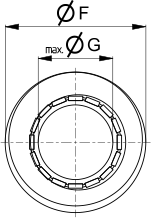
| Series | Stall torque | Peak torque | Inner diameter (F) | Outer diameter (G) |
|---|---|---|---|---|
Series TGQ1 | Stall torque 2.3 - 8.5 Nm | Peak torque 4 - 34 Nm | Inner diameter (F) 42 mm | Outer diameter (G) 79 mm |
Series TGQ2 | Stall torque 7 - 26 Nm | Peak torque 26 - 102 Nm | Inner diameter (F) 72 mm | Outer diameter (G) 120 mm |
Series TGQ3 | Stall torque 10 - 42 Nm | Peak torque 26 - 168 Nm | Inner diameter (F) 86 mm | Outer diameter (G) 150 mm |
Series TGQ4 | Stall torque 15 - 68 Nm | Peak torque 44 - 204 Nm | Inner diameter (F) 106 mm | Outer diameter (G) 180 mm |
Series TGQ5 | Stall torque 28 - 134 Nm | Peak torque 84 - 402 Nm | Inner diameter (F) 148 mm | Outer diameter (G) 210 mm |
Series TGQ6 | Stall torque 60 - 258 Nm | Peak torque 240 - 1032 Nm | Inner diameter (F) 210 mm | Outer diameter (G) 290 mm |
Series TGQ7 | Stall torque 105 - 469 Nm | Peak torque 235 - 1407 Nm | Inner diameter (F) 265 mm | Outer diameter (G) 360 mm |
For detailed electrical, mechanical and performance characteristics, refer to the individual motor datasheets.
Torque Motors and Servo Drives
Torque motors require an appropriate servo drive to control motor current, torque and rotational speed.
The servo drive regulates the motor phases based on rotor position feedback and the required operating conditions.
Depending on the application, the drive system may also require an external position sensor, such as an encoder or resolver, to provide accurate rotor position information.
The selection of a compatible servo drive depends on the motor's electrical parameters, required peak and continuous currents, supply voltage and control requirements.
TG Drives provides servo drive solutions for industrial motion control applications. Contact us to discuss the compatibility of TGQ torque motors with your drive system.
Frequently Asked Questions About Torque Motors
A torque motor is specifically designed to deliver high torque at relatively low rotational speeds. It is typically used in direct-drive applications, where the motor is connected directly to the driven mechanism.
A conventional servo motor often operates at higher speeds and may require a gearbox to achieve the required output torque.
A direct drive motor is a motor connected directly to its driven load without an intermediate mechanical transmission.
This arrangement eliminates transmission-related backlash and can improve positioning accuracy, mechanical stiffness and dynamic response.
Torque motors are one of the most common motor types used in direct-drive systems.
Yes. A properly controlled torque motor can generate and maintain torque at zero rotational speed.
This capability is particularly useful in positioning applications where the motor must hold a mechanical load without rotating.
The permissible continuous standstill torque depends on the motor's thermal design and cooling conditions.
No. Torque motors are designed for direct-drive applications and typically do not require a gearbox.
However, the suitability of a gearbox-free solution depends on the required output torque, speed, inertia and mechanical design of the application.
Continuous torque is the torque a motor can deliver under specified thermal operating conditions without exceeding its permitted temperature limits.
Peak torque is the higher torque available for limited periods, typically during acceleration or other demanding operating conditions.
The permissible duration of peak torque depends on the motor and its operating conditions.
Need Help Selecting a Torque Motor?
Choosing the right torque motor is essential for achieving the required performance, accuracy and reliability of a direct-drive system.
The TG Drives team can help you select a suitable TGQ motor based on your application's mechanical and electrical requirements.
Contact us to discuss your application or request technical assistance with motor selection.