


All offered AC synchronous servomotors feature a distributed three-phase winding in the stator and permanent magnets on the rotor.
The winding is designed for sinusoidal current and voltage waveforms.
Rare-earth magnets (neodymium/iron/boron) are placed on the surface of the rotor.
Low cogging torque (up to 3% of Mo) is achieved by skewing the stator winding slots or the rotor magnets.
The stator of a standard motor is always integrated into an external aluminum housing. The motor bearings are positioned in the front flange and rear shield. Cooling of a standard motor is mainly achieved through the front flange and partially via the aluminum housing (profile). Therefore, motors always require flange mounting. The mounting surface should be at least 2.5 times the area of the motor flange itself.
Feedback sensors are mounted in the rear housing, where connectors or cable glands are also located.
Key Features of Servomotors:
- Design: Flange-mounted, B5
- Colour: Matte black
- Bearings: Sealed ball bearings with permanent grease filling
- Protection rating: IP64 (IP54 on the shaft side), optional up to IP67 including the shaft
- Winding insulation class: F (H upon request)
- Cooling: Convection (Type A)
- Temperature: According to ČSN EN 60034, temperature rise Totep = 110 °C, ambient temperature up to T = 40 °C
- Duty cycle: Continuous (S1)
- Electrical connection: Connectors, mating connectors, or optional cable outlets upon request
- Thermal protection: Thermal protection is ensured by thermal contacts or thermistors (PTC,NTC sensors) embedded in the motor winding. Thermal sensors are set to prevent winding temperatures from exceeding 150 °C. The type of thermal protection must be specified.
- Holding brake: All servomotors can be equipped with an electromagnetic brake. The brake is not intended for positioning but for mechanically securing the motor in a stationary state. The brake supply voltage is typically 24 VDC − 0% +10%.
Feedback Sensors:
Servomotors can be modified for installation to various types of feedback sensors.
Commonly used sensors:
- Resolver (selsyn, fázový rozkladač) – a brushless electrical machine used for rotor position measurement and determining commutation angles.
Sensors with purely digital communication:
Position, temperature or vibration, and motor type data are transmitted to servo amplifiers via a high-speed data channel. These sensors are always absolute – single-turn or multi-turn – and come in various resolutions (14–24 bits/rev).
- DSL (motors with this sensor typically have only one connector or cable)
- BISS-C
- EnDat 2.2
- EnDat 3 (motors with this sensor typically have only one connector or cable)
- DriveClick
Sensors with combined signals (data channel + incremental signals):
An absolute position is determined via the data channel. Incremental pulses or periods are used for more precise positioning. These sensors can be absolute – single-turn or multi-turn. Accuracy is determined by the number of pulses (periods per revolution) and interpolation capabilities in servo amplifiers.
- Hiperface
- EnDat
- BISS/SSI
Comcoder – Hall sensors + incremental sensor:
Commutation position is determined using commutation signals from three Hall sensors. Incremental signals are used for more precise position determination.
Special Designs and Certifications
ATEX Design
Selected types of synchronous AC servo motors can also be supplied in ATEX II 3G certified design - for use in industrial environments with potentially explosive atmospheres formed by gases, vapors, or mists.
UL Certification
Selected types of synchronous AC servo motors can also be supplied with UL certification for use in markets where compliance with relevant North American safety requirements is required.
Standard Servo Motor Series
Standard servo motors are manufactured in 10 sizes (25x25mm to 240x240 mm), with at least 3 length variants in each size. The range of stall torques is from 0.03 Nm to 115 Nm. Motor speed and bus voltage can be selected.
Available Motor Sizes
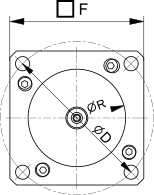
| Series | Stall torque | Peak torque | Frame size (F) | D | R |
|---|---|---|---|---|---|
Series TGH0 | Stall torque 0.030 - 0.090 Nm | Peak torque 0.07 - 0.17 Nm | Frame size (F) 25x25 mm | D ⌀28 mm | R ⌀20 mm |
Series TGS1, TGT1 | Stall torque 0.10 - 0.30 Nm | Peak torque 0.3 - 1.2 Nm | Frame size (F) 37x37 mm | D ⌀32 mm | R ⌀25 mm |
Series TGN2, TGT2, TGH2 | Stall torque 0.3 - 1.1 Nm | Peak torque 0.7 - 4.5 Nm | Frame size (F) 55x55 mm | D ⌀63 mm | R ⌀40 mm |
Series TGMA | Stall torque 0.8 - 3.0 Nm | Peak torque 2 - 11 Nm | Frame size (F) 64x64 mm | D ⌀70 mm | R ⌀50 mm |
Series TGN3a, TGT3a, TGH3a | Stall torque 1.1 - 4.8 Nm | Peak torque 3 - 14 Nm | Frame size (F) 75x75 mm | D ⌀90 mm | R ⌀60 mm |
Series TGN3, TGT3, TGH3 | Stall torque 1.1 - 4.8 Nm | Peak torque 3 - 14 Nm | Frame size (F) 86x86 mm | D ⌀100 mm | R ⌀80 mm |
Series TGN4, TGT4, TGH4 | Stall torque 3 - 11 Nm | Peak torque 10 - 34 Nm | Frame size (F) 98x98 mm | D ⌀115 mm | R ⌀95 mm |
Series TGN5, TGT5, TGH5 | Stall torque 12 - 24 Nm | Peak torque 36 - 72 Nm | Frame size (F) 142x142 mm | D ⌀165 mm | R ⌀130 mm |
Series TGN6, TGT6 | Stall torque 18 - 44 Nm | Peak torque 51 - 132 Nm | Frame size (F) 190x190 mm | D ⌀215 mm | R ⌀180 mm |
Series TGN7, TGT7 | Stall torque 30 - 78 Nm | Peak torque 85 - 234 Nm | Frame size (F) 190x190 mm | D ⌀215 mm | R ⌀180 mm |
Series TGT8 | Stall torque 40 - 115 Nm | Peak torque 120 - 345 Nm | Frame size (F) 240x240 mm | D ⌀265 mm | R ⌀230 mm |
Detailed electrical, mechanical, and performance parameters can be found in the datasheets of individual motors.
Typical Applications
CNC Machining Centers
Servo motors provide precise positioning and dynamic control of the feed axes of machining centers. They enable rapid speed changes and accurate coordination of the movement of individual axes.
Industrial Robotics
In robotic applications, servo motors provide precise control of position, speed, and torque of individual motion axes. Their high dynamics enable fast and repeatable execution of work cycles.
Winding and Unwinding Equipment
Servo drives allow control of speed and torque during winding and unwinding of material. They help maintain the desired material tension even when the roll diameter changes.
Packaging Machines
Servo motors enable precise synchronization of the movements of individual mechanisms in packaging machines. They are used, for example, in dosing, material feeding, cutting, and sealing of packages.
Assembly and Automation Lines
Servo motors provide precise positioning, handling, and synchronization of individual work mechanisms. They enable flexible control of automated manufacturing processes.
Frequently Asked Questions
A synchronous servomotor operates in synchronism with the frequency of the supply field, and its rotor is typically equipped with permanent magnets. An asynchronous motor, on the other hand, operates on the principle of electromagnetic induction, whereby the rotor rotates with a certain slip relative to the stator's magnetic field.
Permanent magnet synchronous servomotors generally offer higher efficiency, better dynamic performance, and higher torque relative to their size.
A servomotor uses feedback to control position, speed, or torque. A stepper motor, on the other hand, typically operates by executing individual steps, often without direct feedback on the actual rotor position.
Servomotors are particularly suitable for applications requiring high dynamic performance, smooth motion, and precise control under varying loads.
BLDC (Brushless DC) motors and AC synchronous servomotors are very similar in terms of their construction. Both typically use permanent magnets in the rotor and multi-phase windings in the stator.
The main difference lies primarily in the commutation and control methods. BLDC motors traditionally feature a trapezoidal back-EMF waveform and use rectangular current waveforms, whereas AC synchronous servomotors typically operate with sinusoidal current waveforms and field-oriented control.
Sinusoidal control enables smooth operation, low torque ripple, and precise speed and position control. AC synchronous servomotors are therefore particularly well suited for demanding industrial applications, CNC machines, and robotics, where high positioning accuracy, dynamic performance, and smooth motion are essential.al.
An AC synchronous servomotor is typically controlled by a dedicated servo drive. Based on feedback from an encoder or resolver, the servo drive determines the rotor position and speed and adjusts the currents in the motor windings accordingly.
This enables precise control of the motor's position, speed, and torque.
Servo Motor Selection and Configuration
To select a suitable synchronous servo motor, use our online configurator. You can filter motors by required torque, power, speed, voltage, frame size, and feedback sensor type.
The configurator helps you find a suitable motor from our standard product range. Detailed technical specifications and datasheets are available for individual motors.
Need a custom motor configuration?
If the configurator does not offer the required combination of parameters, you can select a motor with the closest matching specifications and send us an inquiry. Thanks to our in-house development and manufacturing capabilities, we also offer custom mechanical and electrical modifications to servo motors to meet the requirements of specific applications.
Contact us and we will help you select the right motor and adapt it to your drive system.